The Traditional Three Day Fast

- Why should the Church position this fast in this liturgical sequence, just weeks after Epiphany and 18 days before Great Lent?
- Why should the Church devote so much attention to a short book by an obscure and disobedient prophet?
- How could a story of an unwilling prophet, with a single reference to him in 2 Kings 14: 25, who gets swallowed by a fish when he tries to escape doing God’s will carry such a profound meaning?
- Why does our Church give so much significance and importance to the Three-Day Lent?
The Book of Jonah tells about Jonah’s personal encounter with the LORD. But Jonah’s prophecy speaks to us not much with words but more with symbols. The Church sees within this book’s simple story an icon of Christ symbolically represented. Like this world, Nineveh certainly deserved to be destroyed because of its great sin and evil. When the people of Noah’s day persisted resolutely in their evil, God destroyed the Old World by flood. But the infinitely merciful God does not truly desire the death of the sinner, but that he should repent and live. And so the word of the Lord came to Jonah to go to Nineveh (symbolizing the world) to repentance. But Nineveh’s salvation was not to be achieved by mere preaching and ardent sermons alone but by a sacrificial washing away of the people’s sins in yet another
kind of flood (death and destruction).
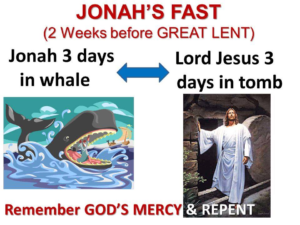
Understanding these symbols spiritually, we behold the mystery of salvation in Christ symbolically. Indeed, Book of Jonah portrays a unique instance of God’s love and concern not just for His own people, Israel, but for a nation of Gentiles who were actually Israel’s enemies. Here again we find an archetype of CHRIST’S MISSION OF SALVATION extending beyond His own chosen people to embrace the whole world, even all the enemies of God.
In the very beginning, when the world was in chaos ‘THE SPIRIT OF GOD MOVED UPON THE FACE OF THE WATERS’ setting the work of creation. After the flood, when God had begun to “recreate” the earth, A DOVE, A SYMBOL OF THE HOLY SPIRIT, was sent out to pass over the waters and return as a sign of safety and life to Noah. On the shores of the Red Sea, God’s creative work of salvation for Israelites, began, When He caused the sea to go back by A STRONG EAST WIND ALL THAT NIGHT, and made the sea dry land, and the waters were divided. In the same way, God began to prepare the means of Nineveh’s salvation, be sending OUT A GREAT WIND INTO THE SEA, A MIGHTY TEMPEST. Jonah was a “dove”, which as in Noah’s case, would become a sign of life and safety for the Ninevites. The image of “wind into the sea” is a clear sign of the presence of the Holy Spirit of God creatively renewing His creation.
All of these images are archetypes, which foreshadow God’s ultimate salvation of this world. These signs were obvious when our Lord Jesus Christ revealed Himself to Israel at His Baptism. “He went up straight out of the water, and the heavens were opened unto Him, and He saw the Spirit of God descending like a dove, and lighting upon Him” (Matt. 3: 16). The symbols here signal that our Lord is manifesting Himself not just as a Redeemer but actually as a “Renewer” of His creation. St. John the Baptist and Forerunner witnessed the meaning of these images of this world’s ultimate salvation “by water and the Spirit.”
In this dramatic passage, God paints us an icon of Christ Himself. Surely, although the mariners do not wish to perish, the alternative of throwing Jonah into the sea is overwhelming for the men to accept. They continued to strive by their own limited means to save themselves. But at last, exhausted, they relented and obeyed the will of the Lord and trusted God. If the ship (emblematic of the Church) perishes, the city (symbolic of the world) certainly cannot survive the storm of destruction their sin has brought. Only the sacrifice of one man can save them both, the first by its willing participation in the sacrifice ordained by God and the latter by heeding God’s call to repentance and accepting the benefits of that sacrifice.
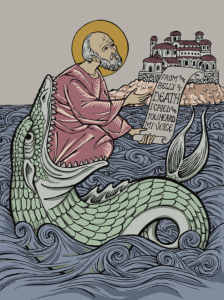
“Almighty God, loved His own who are in the world and gave Himself up for our salvation unto death which reigned over us, whereby we were bound and sold on account of our sins. He descended into Hades through the Cross.” Of course, Jonah’s emergence from the fish after three days and nights foreshadows archetypally Christ’s Resurrection. After being disgorged from the bowels of “Sheol”, the Jonah who entered the fish had died and he strikes the shores as a man transformed as a “new creature”. Jonah, now no longer seeks to flee God’s presence but rather rushes off gladly to do God’s call. How this “transfiguration” occurs in those abysmal depths remains a mystery to us. He gives us all the necessary elements: the wind sent out into the sea, the three days’ sojourn in a watery Hades, and the coming forth of a “new man” from the grave. All of these types should have been obvious in their symbolic meaning to a man as well versed in the Scriptures as Nicodemus. “Verily, verily, I say unto thee, except a man be born of water and of the Spirit, he cannot enter into the Kingdom of God. (Jn. 3: 5). Only by Baptismal Resurrection could Jonah, the sinner, have the power to please God and the right to serve Him in His Kingdom.
Jonah preached to the Ninevites. Their response was as instantaneous and as heartfelt, as the Ninevites trembled at the voice of Jonah, the son of Ammittai, and took refuge in penitence, fasting, prayers, tears and groans. The people from high to low estate collectively donned sackcloth and fasted for forty days and nights. God annulled the sentence of judgment pronounced by Jonah concerning the destruction of Nineveh. If we are truly honest with ourselves, we know ourselves to exceed the Ninevites in evil and to fail them in repentance. Our fasting is hardly from the deepest parts of our hearts. Rather than wearing sackcloth, we prefer luxury and lasciviousness. And if any of us actually “cries” unto the Lord, who among us cries mightily? Who has really turned from his evil way and the violence of his hands?
For this reason, our Lord Jesus Christ fasted in the desert forty days and nights on our behalf. Only the fasting of the God-man is truly pure, powerful, and acceptable to the Lord. By fasting then, He fasts with us now to compensate for and to complete our lukewarm fasting, so that it might rise as a sweet-smelling savor to the Lord and Creator. But just as the people of Nineveh fasted together as one, so do we together with one another in Christ. In Him, we form a sacred community of believers who are the Body of Christ. This Body is indeed a “Communion of Saints”, Saints perfected in their striving done in unity with the Head of the Body.
Lest we fail to emphasize it, both Jesus’ Baptism and Jonah’s watery descent were followed by fasts of the sacred number of forty days. The relationship between Baptism and fasting and the analogy between the “Sign of Jonah” and the mystery of salvation in Christ’s death and Resurrection inspired the Church to place the Fast of Nineveh between the Feast of Epiphany and Great Lent. Like God in His verbal icon found in the Book of Jonah, the Church draws together these archetypal themes to instruct Her children using symbol and liturgy in the need to follow the Lord Christ in all things.
After God had lifted him up to partake in His mystery of salvation, Jonah returns to his sinful self with a vengeance. We, like Jonah, only too easily turn from participation in God’s mysteries of grace and loving-kindness to descend once again to lap the vomit of our sinfulness like dogs! Like Jonah as well, we are ever free, by God’s design, to renounce repentance at any time, even after receiving great spiritual gifts of His favor. But, thanks be to God, the Lord also doesn’t give up on Jonah (or us) that easily. In the plant that springs up in a night to be killed the next night, God gives Jonah an object lesson in the preciousness of all life in God’s eyes. We who call ourselves Christians really cannot stand in judgment of poor Jonah. We also fail to live up to our calling in “the Sign of Jonah.”
Jonah did not have luxury accommodations nor did he travel tourist class. But, his quarters had been a little cramped, with no space to move and there wasn’t any light. And I am certain that at first, he thought he was going to die. And what did he do? Well, like a lot of people who find themselves unexpectedly in a mess, he prayed. Isn’t this the way of the world? Very many people know that there is a God. They know that he has at least Ten Commandments. And yet, like Jonah, they run away. At least until, they too end up in the jaws of a predicament. And like Jonah, very many people pray to God in their despair! Like Jonah, you too have fled from what God has commanded.
God presents us with an icon of Christ in the Book of Jonah. He also shows us ourselves in the people of Nineveh, the ship’s mariners, and even Jonah. Whether in the world, the ark of the Church, whether abject evildoer or blessed Saint, we are all of us, sinners, perpetually in need of renewal in the “Sign of Jonah”, the glorious restorative power of the Resurrection in Baptism. The Church invites us to fast together in the Body of Christ, not to prove our worthiness or to make restitution, but to become one with Christ in His mystery of salvation. The Church exhorts us to “be transformed by the renewing of (our) mind, that (we) may prove what is that good, and acceptable, and perfect will of God” (Rom. 12: 2). Hence this fast is of Mystical significance to the Church.
The three-day lent is one of the Rigorously and Traditionally observed, Symbolic and Unique fasts of the Orthodox Churches, commemorating the three days of fasting that Prophet Jonah undertook inside the fish.
The faithful traditionally refrain from food and drink for three consecutive days, from Monday till Wednesday! Some observe the fast by refraining from food and drink from morning till sunset during the three days. The church enjoins you to at least refrain from meat, fish, dairy products and all worldly entertainment during the period of fasting. The faithful are urged to go to church after this fast (or the following Sunday) and receive the Holy Qurbana (Holy Eucharist).
The fast is unique in its positioning in the liturgical sequence, its significance and duration. The Book of Jonah, one of the shortest books of the Old Testament, has a very important place in the Church’s liturgical year.
0 Comments