Characteristics of Orthodox worship
The Liturgy of the Orthodox Worship is not just words, but an action, with Participation ………… integrating all aspect of a human person. The Orthodox worship provides complete form of worship and contains all required elements of worship……..…. ~ Dr. Paulose Mar Gregorios.
The Worship of the Orthodox Church is the Church’s Basic, Prime, Fundamental activity because the worship of Triune God joins and unite man to God, thus is the essential function of Christ’s Church – Heavenly Unique Beautiful. The Beauty of Orthodox worship must be experienced to be understood. Orthodox divine services are a priceless treasure, that knits together Prayers, Praise, Thanksgiving, Communion, Intercession, Scripture Readings, Confession of Faith, Invocation and teaching… Orthodox Worship that has the distinctive flavor, rich traditions, prescribed order and living faith of Orthodoxy TO BE truly EXPERIENCED.
What is the Aim & Purpose of Orthodox Christian Worship?
Worship is our highest calling, as well as our ultimate end. It needs no purpose—because it is the purpose. But what happens in worship to make it so important?
Why do we gather every week for corporate worship? It is in response to God’s ultimate call to true, or right, worship, which is the definition of orthodoxy: “right doxology”—true doxa—true glory. God universally calls all humankind to true “worship,” right “adoration.”
•Adoration and Union with God – ‘ad’ (to, near to) and the verb ’orare’ (to speak, or pray). Adoration constitutes our call to an intimate face-to-face, or even mouth-to-mouth, relationship with our Creator, which is the essence of right worship. Let Him kiss me with the kisses of His mouth, for your love is more delightful than wine. 3Pleasing is the fragrance of Your perfumes, Your name is like perfume poured out. Pleasing is the fragrance of Your perfumes; Therefore, the young maidens love you, they draw you, we will run after You…….. (Song of Songs 1: 1-3)
Perfumes (myrrh) – The Holy Spirit; Fragrance is the Gifts of the Holy Spirit. Young maidens – are we, the Christ’s chosen ones, born again through Holy Chrismation. We, are the we the chosen ones, the Church, made of multitude of faithful souls.
“The worshipper attains a deeper and richer state of experiencing Christ, than in any form of worship – the frequent participation in Eucharist, renders the unique experience of heavenly bliss more and more real, beyond words can express” – ~ LL Dr. Paulos Mar Gregorios
Jesus Christ dwells or resides in the believer who worthily receives the Holy Sacrament expelling all the resisting forces of Satan. When we regularly partake the Holy Communion, with total adequate preparation, gradually the rays of divine light spreads in the heart and make it glow, making the believer a part of the Divine Nature. The Lord so communicates His body to us there that He made completely one with us and we with Him. ~ St Basil the Great
Salient Features Orthodox worship
1. Orthodox Church is an Ancient Apostolic Church
The Orthodox Church historically stands in direct continuity with the earliest Christian communities founded by the Apostles of the Lord Jesus. The Orthodox Churches are the oldest Churches in the world, that asserts on apostolic foundation, and that its historical roots can be traced to the early Apostolic Periods of the 1st century and maintaining the continuity of the leadership, Life, Teaching, Traditions, practice of the ancient Orthodox Apostolic communities.
It is a living Church community, continuing the life in the Holy Spirit, passed on from generation to generation in the same community, adhering to and incorporating venerable the Apostolic Traditions and successions. The Oriental Orthodox Church – is an ancient Apostolic Oriental Orthodox of which Blessed Virgin Mary is the Patron Saint. She is seated on the Right side of Jesus. The Malankara Orthodox Church – is an ancient Apostolic Church of the St. Thomas Christians that originated from the evangelical labours of St. Thomas, Christ’s Apostle and the Patron Saint of the Indian Orthodox Church.
2. Orthodox worship is “God-centered,” not “man-centered.”
We strive to please God, through worship and life style, not ourselves. Our worship is focused on God, not on our own enjoyment, fulfillment. We offer ourselves, commending ourselves to one another, in recognition of the fact that we have been created in the image and likeness of God. We offer our worship and adoration of God “on behalf of all, and for all,” joining our voices, minds, hearts, and souls with all of the faithful who “in all ages have been well pleasing unto God.” Orthodox Churches still use forms of worship that were practiced in the first centuries. Our worship is based to a great extent on passages from Scripture. Values that are “Judeo-Christian” have never left Orthodoxy
Characteristics of Orthodox worship
1. The Entrance into & the Awareness of the Presence of God in Worship:
God is Omnipresent. He is everywhere,” But He is here. Church is house of the One Holy Triune God. We have come to His House to see Him and talk to Him face to face. This is the main characteristic of Orthodox worship – Architecture of Church, Prayers, Hymns, Curtains, objects used in Madbaha, Candles Lights, Vestments & Attires of celebrants, Actions and Gestures, Colours, Thronos, Rituals, Orderly Liturgy, Processions, Singing, Chantings, Sounds, the pleasant fragrance of incense that fills the Church, Blessings and Benedictions, Postures, Signs and Symbols disciplined participation of the people, the recitation of different prayers and hymns, ……………. are all seen as characteristics of Orthodox worship. All these elements have just one purpose: create an awareness of presence of God in worship; to experience the joy of presence of God. All these together transform the worshipping community to a Temple of God. These facets in worship is said to be the entry points to the presence of God. In Orthodox worship, we see God face to face, talk and experience His Presence’.
2. Joy of Worship; Joy in Worship:
Worship of Orthodox Church, we have a joyous atmosphere. We worship in Joy. This Joy comes up from our awareness of presence of God. Heaven is opened before the believers, who take part in the eternal worship of heaven. Orthodox believers‘ worship with the feeling of joy of the kingdom of heaven. This joy is an expression of our belief in the Resurrection of Christ and the Deification of humanity, Two are dominant themes of Orthodox Worship. We celebrate the Joy of Risen Christ and the Joy of Eternal Life. There is no genuine spirituality without joy. “Now, the dwelling of God is with men, and He lives with them.
They will be His people, and God Himself will be with them and be their God” (Rev. 21: 3–4).
“Rejoice and be exceedingly glad, for great is your reward in heaven . . .” (Mt 5. 11).
… And God has raised us up with Christ and seated us with Him … Eph. 2: 6.
As Orthodox Christians, we express a deep and pervasive sense of joy.
The Joy of not being “left as orphans” (John 14: 18); end of the age (Mt 28: 20).
The Joy of being given the gift of the Holy Spirit. The Joy that we do worship the Light of Christ and that we carry within us the Light of Christ, and we are called to be the Light of Christ in the world. Ps. 36:9; – Jn. 8: 12.
The life awaiting us, at the land of Eternal Light is here in our worship. Joy is an essential element of the spiritual life, one of the “Fruit of the Holy Spirit” (Gal 5: 22).
3. Strong Biblical basis – Liturgy that is Rich in Biblical Portions
Holy Scripture is the foundation on which Orthodox liturgy is set up. Orthodox worship gives expression to our faith, that is grounded in Scriptures. Holy Bible is the point of origin of all prayers in Orthodox tradition. Orthodox Worship preserves the intimate & inseparable relationship the between Bible and Liturgy. In Holy Qurbana, Holy Sacraments, Canonical Prayers and all such occasions.
Scripture portions, particularly from gospels are read with due importance. The liturgy has abundance of prayers from Bible & plenty of Psalms. Most prayers are expressions or meditations on Biblical thoughts or incidents. The Sedro of Syrian Church tradition are rich in portions taken from Scriptures. The Sedro each feast day are from the Bible readings marked for that feast. The Sedro we have for the Passion Week are mediations on the Biblical illustrations of the tribulations and passions underwent by Jesus. Our task, then, is to express this biblical faith through the Liturgy of the Church, thus, “ascribe praise and glory, thanksgiving and worship: to the Father, & to the Son, & to the Holy Spirit, now & ever & unto ages of ages.”
4. Orthodox Church gives the most importance and maximum reverence to the Holy Bible
In the Church, the Holy Bible is kept on the Namaskara Mesha. The Holy Gospels, the written Word of Living God (Jn. 1: 1). Evangelion are the Words of the Word of God. Is a large ceremonial book containing the four Gospels for proclaiming the Gospel at liturgical celebrations. The Good News of Orthodox Christianity is a proclamation of God’s unbounded and sacrificial love for man kind, as well as the revelation of the true destiny of the human person. The good news is that man is no longer an outcast nor expelled from God’s Kingdom; but that he is again a son, again God’s subject. ~ St Gregory of Nyssa.
This Gospel, the Word of God symbolizes Christ and the stand as God’s Throne. For this reason, veneration and sanctity is attached to this Table (Lectern). The priest or deacon entering the sanctuary kisses the Gospel, before kissing the four corners of the Holy Altar. The correct place is the Right Side of the Holy Altar, but may be for sake of convenience of priests or deacons, it is kept on the left side of Altar. When the gospel is read, we are receiving Christ, Himself, The Word.
However, the Gospel is not just a book but is the Voice of Christ Himself. The celebrant takes the ornately bound Evangelion and elevates it high over his head. Lifting up, the Gospel book is a sign of the authority of God’s Word over our lives. The Gospel Book is carried in procession at specific times and feast days, accompanied by candles and Sacramental Fans. Christ is revealed in the Proclamation of the Gospel (Word of God). This corresponds to His revelation by His body & His blood (Word Himself). Proclaiming or hearing the Gospel, we stand upon this vertical heavenly road, and walk upon it to Paradise. A Gospel is kept resting on the chest when a priest or bishop is buried. This signifies his vocation to preach the Gospel to all men and during the funeral service for a priest and bishop there are several readings from the Gospels, to indicate the importance of the Gospel to his ministry. When a Synod of bishops meets, a Gospel Book and a Holy Cross is often enthroned in a prominent place to show that Christ Himself presides over the meeting.
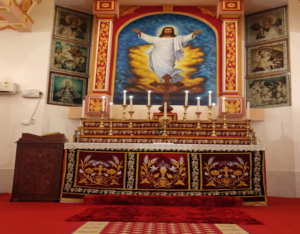
The Holy Gospel in special place called, ‘Evangelion Table; in the Madbhaha (Holy of Holies), at the right side of the and adjacent to the Holy Altar Altar. The word of God that is kept at the right side of the Altar, as Jesus Christ the Word, sits at the right-hand side of God. Mark 16: 19; Heb 1: 3; Col 3: 1; Acts 2: 33; Acts 7:56; 1 Peter 3: 22; Rom. 8: 34; |
Mark 16:19 – After the Lord Jesus had spoken to them, He was taken up to heaven & He sat at right hand of God.
Heb. 1: 3 – The Son is the radiance of God’s glory………….. After He had provided purification for sins, He sat down at the right hand of the Majesty in heaven.
Col. 1: 3 – Since, then, you have been raised with Christ, set your hearts on things above, where Christ is, seated at the right hand of God.
Acts 2: 33 – 33 Exalted to the right hand of God, he has received from the Father the promised Holy Spirit and has poured out what you now see and hear.
Acts 7: 56 56 “Look,” “I see heaven open and the Son of Man standing at the right hand of God.”
1 Pet 3: 22 – 22 who has gone into heaven and is at God’s right hand—with angels, authorities & powers
Rom. 8: 34 – 34 Who then is the one who condemns? No one. Christ Jesus who died—more than that, who was raised to life—is at the right hand of God and is also interceding for us.
There is not one prayer or sacramental service without readings from the Holy Bible or proclamation of Gospels. The Evangelion Mesha is brought to the Centre of Sanctuary (Madbaha/Holy of Holies). Chief celebrant brings the Gospel accompanied by lighted candles and Sacramental fans, in a procession. Lighted candles (2) symbolize believers and John the Baptist (1). Marbahso are rung to symbolize presence of Heavenly Hosts, angelic community. The two lights carried with the gospel are both a token of joy and a symbol of Christ, the light of the world (John 8:12). Incense is offered and the smoke rises from the censor as the Evangelion is being proclaimed. The Light is an image of a pure life, and the sweet fragrance of incense also symbolises, finally, a virtuous, God-fearing life… Bells remind Noah heralding the Kingdom of God. “Just as it was in the days of Noah, so also will it be in the days of the Son of Man” Lk. 17: 26. Practical, a call to a solemn occasion, to pay attention. Deacon admonishes or sings to the congregation to stand still or stand well in reverence with sober minds and listen to the living Words of God. (With calmness and reverence and with sober minds, let us give heed, and listen to the Proclamation of the living words of God, in the Holy Gospel of our Lord Jesus Christ, that is read to us. Christ our Lord, is present in the Gospel.
The celebrant kisses (bows) and proclaims the Holy Gospel of Jesus Christ, life and redemption to the world. The Gospel is never read but proclaimed or chanted. In the Orthodox Tradition the faithful Congregation will stand, to listen to the Holy Gospel and never should be sitting.
Readings from Old and New Testaments and from the Gospels are part of our liturgy.
Plenty of Psalms are included in each hourly prayer. Ps. 51, 14o, 141, 91, 121, 133, 148, 149, 63, ..
Besides biblical passages are included in several songs and prayers.
The prayer cycle called ‘Kukillion’ which is very important in Orthodox liturgy always begins with the singing of a Psalm. Ninnal sthuthiyodu raajamakal – Ps: 45:9-11; Nayavaan panapole thalirthidume – Ps. 92: 12-14; Charrthum neethiya ninnaach- aaryanmaarum – 2 Chron : 6:41 -42. Ps 132 :9-10; Makkalilappan krupa cheyvathu – Ps 103: 13 -15. Those who attend the worship meditatively will undoubtedly be surprised at the biblical scholarship of our Church Fathers.
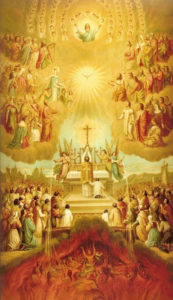
5. A Replica and Reflection of Perpetual Heavenly Celestial Worship
Orthodox worship is patterned after heavenly worship. Thus is a participation and replica of the heavenly worship Is. 6: 3 – “Holy, holy, holy is the Lord of hosts; the whole earth is full of his glory! Rev. 4: 8 “Holy, holy, holy, is the Lord God Almighty, who was and is and is to come!” Orthodox Worship draw no distinction between the Body of Christ in heaven and that on earth. Views both parts of the Church as inseparable and in continuous worship together of God. Orthodox worship expresses this unity of earth and heaven in every possible way so that the earthly worshippers are continually reminded through all their senses of the heavenly state of the Church. In the Divine Liturgy the Holy Church sings: Holy, Holy, Holy, Lord of Hosts, heaven and earth are full of your glory. Hosanna in the highest. Blessed is he who comes in the name of the Lord. Hosanna in the highest.
In the year that King Uzziah died, I saw the Lord, high and exalted, seated on a throne; and …………. 2Above him were seraphim, each with six wings: With two wings they covered their faces, with two they covered their feet, and with two they were flying. 3And they were calling to one another- Is. 6: 1-3. Day and night they never stop saying: “‘Holy, holy, holy is the Lord God Almighty,’ who was, and is, and is to come Rev. 4: 8
The rich-coloured vestments worn by Orthodox priests is the heavenly prototype, colorful decorated altar, lit candles and the air permeated by the sweet smell of incense was very much a part of the heavenly worship. All these things are meant to draw our minds upwards, away from the cares of this life. The rich worship enlightens the mind through the heart. Worship on Earth, as it is in heaven. “We knew not whether we were in heaven or on earth, for surely there is no such splendor or beauty anywhere on earth. We cannot describe it to you; we only know that God dwells there among men and that their Service surpasses the worship of all other places… We Ascend to heaven, to the Kingdom of God.
6. Communication with the Five Senses.
The five sense help us in human communications. We use all these five senses to commune with God. In real worship we see, hear, smell, taste, touch and experience the divine communion. Preaching the word of God and listening and meditating the Promeon, Husoyo and Sedro, all the prayers and hymns elevates our communication with God. Symbolic meanings of the three-fold colors of the decorated Holy Altar. The Body and Bl0od of Christ were given to the Church and the whole creation is sanctified through the Church. In worship we not just see the beautiful worship, but listen to the word of God, smell the odor of incense, touch the hands of our brethren in Kiss of Peace and taste of the Eternal Food from the Divine Chalice. Worship is an act of the whole man, body, soul and spirit – not simply an act of the mind.
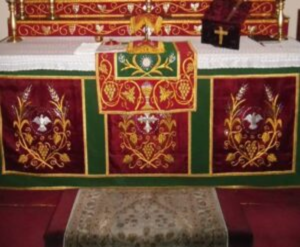
Three pieces of different colours red, green and white. The outer red represents the omnipresence and omnipotence of God the inner green stands for the world and represents the grace of God given through. The innermost white piece stands for the Holy Church, a community of redeemed people
7. Ritual Offerings and Incense.
Ritual offerings and material objects were given sufficient role in the ministry of Jesus.
Luke 5: 14 ‘ And He charged him to tell no one; but go and show yourself to the priest and make an offering for your cleansing as Moses commanded for a proof to the people’. Thus, Jesus commanded to give offering and rites of thanksgiving. Matthew 8:2-4 …..And immediately his leprosy was cleansed. And Jesus *said to him, “See that you tell no one; but go, show yourself to the priest and present the offering that Moses commanded, as a testimony to them.”
Luke 2:22-24 “Every firstborn male that opens the womb shall be called holy to the Lord”, and to offer a sacrifice according to what was said in the Law of the Lord, “A pair of turtledoves or two young pigeons.
There are five main types of sacrifices, or offerings, in the Old Testament.
Burnt offering (Lev. 1; 6:8–13; 8:18-21; 16:24), Grain offering (Lev. 2; 6:14–23), Peace offering (Lev. 3; 7:11–34), Sin offering (Lev. 4; 5:1–13; 6:24–30; 8:14–17; 16:3–22), Trespass offering (Lev. 5:14–19; 6:1–7; 7:1–6). Each of these sacrifices involved either animal or fruit of the field and had a specific purpose.
Ritual Offerings and Incense.
Most were split into two or three portions—God’s portion, portion for the Levites priests, and, if there was a third, a portion kept by the person offering the sacrifice. The sacrifices can be broadly categorized as either voluntary or mandatory offerings. Voluntary Offering
There were three voluntary offerings. burnt offering, grain offering, peace offering, These pieces of the offering were called the “wave offering” and the “heave offering” because they were waved or lifted over the altar during the ceremony. The vow offering, thanksgiving offering, and freewill offering mentioned in the Old Testament were all peace offerings.
Mandatory Offering
There were two mandatory sacrifices in the Old Testament Law.
Sin offering and Trespass offering, Vow Offering and Freewill Offering. Even St. Paul cut his hair at Cenchreae, for he had a vow (Acts 18:18).
Bread, wine, water, oil and soil are traditionally the work of human hands, and are all seen used in the redemptive process according to the Bible. ‘You do this in remembrance of Me, this is My Body and this is My Blood’ commanded Jesus.’ Wheat is grown and ground, transformed by human work to make bread. Grapes are grown and crushed, transformed by human work to make wine. All these manifests also our offerings to Jesus Christ of ourselves, our life and of the whole world. Since love (agape) is one of the constituent aspects of the image of God in man, basically man is a sacrificial being. Love cannot be conceived without the act of sacrifice which is manifested in the self-emptying of son of God to become man and save him. The genuine love is sacrificial in its nature. The same divine aspect in man is manifested in his/her act of worship which is again an act of love as a response to the love of his creator.
Offerings of Incense.
The offering of the incense is practiced in Christian worship Rev. 8 : 3, 4; Rev. 5:8, Heb 9:4, Matt. 2: 11.
•Rev 8:3– 3And another angel came and stood at the altar with a golden censer, and he was given much incense to offer with the prayers of all the saints on the golden altar before the throne,
•Rev 8: 4 – 4and the smoke of the incense, with the prayers of the saints, rose before God from the hand of the angel.
•Rev. 5:8 – 8And when he had taken the scroll, the four living creatures and the twenty-four elders fell down before the Lamb, each holding a harp, and golden bowls full of incense, which are the prayers of the saints.
•Heb. 9: 4 – 4having the golden altar of incense and the ark of the covenant covered on all sides with gold, in which was a golden urn holding the manna, and Aaron’s staff that budded, and the tablets of the covenant.
•Matt. 2: 11 – 11And going into the house, they saw the child with Mary his mother, and they fell down and worshiped him. Then, opening their treasures, they offered him gifts, gold and frankincense and myrrh.
Offering of the incense is to get rid of the plagues to remove the foul smell of sin, to please the Lord with complete dedication and to keep the Biblical commandments Num. 16: 46- 50; Ex. 35: 8, 2 Chron 2: 4, 1 Kg 9: 25, Malachi 1: 11)
• Num. 16: 46- 50 46And Moses said to Aaron, “Take your censer, and put fire on it from off the altar and lay incense on it and carry it quickly to the congregation and make atonement for them, ,,,,,,,,, 47So Aaron took it as Moses said and ran into the midst of the assembly…….. And he put on the incense, made atonement for the people.. 50 And Aaron returned to Moses at the entrance of the tent of meeting, when the plague was stopped.
•Ex. 35: 8 8oil for the light, spices for the anointing oil and for the fragrant incense,
•2 Chron 2: 4 – 4 Behold, I am about to build a house for the name of the Lord my God, dedicate it to him for the burning of incense of sweet spices before him, ‘…….. and for burnt offerings morning and evening, on the Sabbaths and the new moons and the appointed feasts of the Lord our God, as ordained forever for Israel.
•1 Kings 9: 25 – 25Three times a year Solomon used to offer up burnt offerings and peace offerings on the altar that he built to the Lord, making offerings with it before the Lord.
•Mal. 1: 11 – 11For from the rising of the sun to its setting my name will be great among the nations, and in every place incense will be offered to my name, and a pure offering. For my name will be great among the nations, says the Lord of hosts.
•With the offering of incense, we are mingling with the prayers of all the saints. Rev. 8: 4 4and the smoke of the incense, with the prayers of the saints, rose before God from the hand of the angel.
Incense in Our Worship. The priest burns the incense.
The association of incense with prayer and offering has a great deal of biblical support for its place in worship, both in the Old & New Testaments.
•Lord, I have called upon you: answer me. Give heed to my words and receive my prayer as incense before you, the offering (Qurbana) of my hands as the evening offering (Qurbana).” (Ps. 141: 1-2)
•Incense is a symbol of our prayers ascending to God and of His transforming power in our lives.
•Incense is part of the joy and beauty of Orthodox Worship. Incense Shall be Offered to My Name and in Every Place ~ Mal 1: 11
•Lord said (Moses) “You shall make an altar, burn incense on it (Ex. 30: 1).
•“Aaron shall burn on it, sweet incense every morning” (Ex. 30: 7). And also, at twilight “he shall burn incense on it, a perpetual incense before the Lord throughout your generations” (Ex. 30: 8).
•Thus, incense was conditioned to be ‘sweet incense’.
The phrase ‘sweet incense’ is repeated on many occasions in the Holy Bible: (Ex. 25: 6; Ex. 37: 29; Lev. 16: 12).
Incense in Our Worship. The priest burns the incense.
The association of incense with prayer and offering has a great deal of biblical support for its place in worship, both in the Old & New Testaments.
•Lord, I have called upon you: answer me. Give heed to my words and receive my prayer as incense before you, the offering (Qurbana) of my hands as the evening offering (Qurbana).” (Ps. 141: 1-2)
•Incense is a symbol of our prayers ascending to God and of His transforming power in our lives.
•Incense is part of the joy and beauty of Orthodox Worship. Incense Shall be Offered to My Name and in Every Place ~ Mal 1: 11
•Lord said (Moses) “You shall make an altar, burn incense on it (Ex. 30: 1).
•“Aaron shall burn on it, sweet incense every morning” (Ex. 30: 7). And also, at twilight “he shall burn incense on it, a perpetual incense before the Lord throughout your generations” (Ex. 30: 8).
•Thus, incense was conditioned to be ‘sweet incense’.
The phrase ‘sweet incense’ is repeated on many occasions in the Holy Bible: (Ex. 25: 6; Ex. 37: 29; Lev. 16: 12).
Incense in Our Worship. The priest burns the incense.
The association of incense with prayer and offering has a great deal of biblical support for its place in worship, both in the Old & New Testaments.
•Lord, I have called upon you: answer me. Give heed to my words and receive my prayer as incense before you, the offering (Qurbana) of my hands as the evening offering (Qurbana).” (Ps. 141: 1-2)
•Incense is a symbol of our prayers ascending to God and of His transforming power in our lives.
•Incense is part of the joy and beauty of Orthodox Worship. Incense Shall be Offered to My Name and in Every Place ~ Mal 1: 11
•Lord said (Moses) “You shall make an altar, burn incense on it (Ex. 30: 1).
•“Aaron shall burn on it, sweet incense every morning” (Ex. 30: 7). And also, at twilight “he shall burn incense on it, a perpetual incense before the Lord throughout your generations” (Ex. 30: 8).
•Thus, incense was conditioned to be ‘sweet incense’.
The phrase ‘sweet incense’ is repeated on many occasions in the Holy Bible: (Ex. 25: 6; Ex. 37: 29; Lev. 16: 12).
•Ex. 25: 6: olive oil for the light; spices for the anointing oil and for the fragrant incense;
•Ex. 37: 29: They also made the sacred anointing oil and the pure, fragrant incense—the work of a perfumer.
•Lev. 16: 12: Then he must take a censer full of burning coals from the altar before the LORD, and two handfuls of finely ground fragrant incense, and take them inside the veil.
8. Communion of living and Departed Ones.
Church in its wholeness takes part for it is the body of Christ. Those who are alive and those who are departed are participants in this worship. Holy Qurbana, the worship of the Church is the visible form of this heavenly worship. The living believers and departed ones are members & worship together. Both, mutually shares the Heavenly Joy of life in togetherness in Christ. With death, a believer is not separated from the Church. The worship offered by this Body of Christ has the participation of living believers and departed believers. That is our doctrine of faith, we are praying for the departed. In the preparatory service to Holy Qurbana, all the departed ones right from Adam till the Second Coming are remembered. In the Thubden, we have Three intercessory prayers for the faithful, where we seek the intercession of departed. BVM, Apostles, Prophets, Martyrs, Faithful. So, do we seek intercession in the Kukkilions. ……..
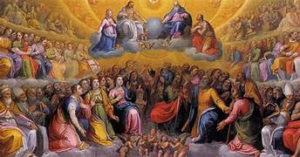
9. Communion and Intercession of/to SAINTS
Latin, Communio Sanctorum / Greek Koinonia Agion. Spiritual union or fellowship of, or with, the saints (holy or set apart) ie. – united and connected with Christ and with all the faithful (His Church), whether on earth or in paradise. When Christians depart this life, they remain a essential part of the Church – the Body of Christ.
They are alive in the Lord and “registered (enrolled) in heaven“
•Heb. 12: 23 23and to the assembly of the firstborn who are enrolled in heaven, and to God, the judge of all, and to the spirits of the righteous made perfect,
They worship God and engage in Divine Liturgy
•Rev. 4: 10 10the twenty-four elders fall down before him who is seated on the throne and worship him who lives forever and ever. They cast their crowns before the throne, saying,
•Inhabit His heavenly dwelling places
•John 14: 2 2In my Father’s house are many rooms. If it were not so, would I have told you that I go to prepare a place for you? In the Eucharist we come “to the city of the living God“.
Join in communion with the saints in our worship of God.
•Heb. 12: 22 – 2But you have come to Mount Zion and to the city of the living God, the heavenly Jerusalem, and to innumerable angels in festal gathering,
•They are that great “cloud of witnesses” which surrounds us, and we seek to imitate them in running “the race that is set before us”
•Heb, 12: 1 – 12Therefore, since we are surrounded by so great a cloud of witnesses, let us also lay aside every weight, and sin which clings so closely, and let us run with endurance the race that is set before us,
Rejecting or ignoring the communion of saints is a denial that those who have died in Christ are still part of his Holy Church.
•The Church reveres, honours or venerates them and seek their intercession, in the prayers and hymns of Eucharistic devotion.
10. Total Participation of Believers
Orthodox Church believes in total participation of Church, Corporate Worship. Celebration of Holy Qurbana, priest is always chief Celebrant, the laity are celebrants. •Priest celebrates Holy Qurbana for the community, as a leader of the worshipping community, Thus, one reason why a priest does not celebrate Holy Qurbana alone. There must at least be one deacon / altar boy and one layman representing the community of believers according to our tradition.
Worship is an experience which involves the entire Church. Worship is a manifestation of God’s presence and action in the midst of His people. God gathers His scattered people together, and it is He who reveals Himself and we enter into His presence. God dwells among His people and that we are created to share in His life. Worship is our corporate response of thanksgiving to the presence of God and a remembrance of His saving actions – especially the Life, Death, and Resurrection of Jesus Christ. Thus, Orthodox Worship is centered upon God. We are mindful of His actions and we respond to His love with praise and thanksgiving. In so doing we (the congregation) come closer to God. Our worship is celebrated by the redeemed community, in the Love of God and through the power of the Holy Spirit that leads us to the Truth, Jesus Christ as the fulfillment.
The community rather than the individual is more important in Orthodox worship. The Church worships God as one community. We have modelled our prayers on Lord Father in heaven. Usages like ‘I, my and mine’ are very rare in Orthodox worship. In most prayers of Holy Qurbana, the term ‘we’ is always used. Almost all the prayers in the Thaksa wind up as ‘To You we offer praises and thanksgiving, ….. Let us give thanks to God the Father, the Lord of all things, and worship His Only begotten Son, and glorify His living Holy Spirit……O You, Who alone are merciful Lord, Who dwell in the high………… & bless them by the grace of Your Only Begotten Son & to Your All-Holy Spirit, Who is Good, Worshipped, life, life-giving and consubstantial to You. However Orthodox worship may seem distasteful for communities which like to pray, ‘Give me my daily bread’ instead of ‘Give us our daily bread’. Holy Qurbana is Celebrated by the faithful & for all the Faithful of our Church and for THE ENTIRE UNIVERSE
11. Symbols and Symbolic Representations
Symbols are something visible and material that points to an invisible reality. Symbolism is an inseparable facet of Eastern liturgy. The Orthodox worship has certain rituals, object, and movements those are symbolic. Symbol can be a ritual or Symbols such as bread made of wheat flour, wine, Chalice, Paten, Thronos and Thablitho Madbhaha, Curtain, Candles, Cross, Gospel Stand (Lectern), Namasakaram Mesha, Censor, Attire of the celebrant, the Baptismal Font/Receptacle for Holy Baptism, Lamp, are all symbols of an Orthodox Church. All are inevitable in Holy Qurbana. Each of these has its own role to express the inner meaning and divine mysterious nature of Holy Qurbana.
The celebrant himself is a symbol; a symbol of Jesus Christ. For the celebrations of Sacraments and liturgical rituals, symbols are inseparable facets. The pompous processions, Benedictions & gestures of celebrant waving his hands, kneeling to touch the forehead on the floor, bowing the head, in reverence, raising hands, other gestures, exchanging Kiss of peace, Kaimuth, breathing over the Baptismal waters are all symbolic gestures in the worship. Each symbol turns meaningful in relation to other symbols. Once a symbol is detached from worship, the symbol may not reveal any meaning.
12. Aims at Transfiguration and Divinization of the Whole being (Body, Mind and Soul).
Human mind is provided with conscious, sub conscious and unconscious layers. Worship is not only transfiguration of the conscious mind, but transforms whole being. St. Paul expresses this process as follows: ‘ And we all, with unveiled face beholding the glory of the Lord as in a mirror, are being transformed into the same image from glory to glory, just as by the spirit of the Lord‘. (2 Cor. 3: 18). The three representatives of the Apostles could experience this Glory of the Lord in their Tabor Transfiguration. The Faithful not only to see the glory of God, but also to become glorified. Human beings, created in the image of God are transfigured from glory to glory through incessant prayer and worship. This process is not intellectual but experiential. The whole being is involved in this process. In other words, worship is infinite growth in goodness. This is Theosis or Deification.
13. The Rich Vision of Orthodox Christian life, is “to become partakers of the Divine Nature”.
The fundamental, essential goal of each Orthodox Faithful is to have the share in the life of God. Created by God to live in fellowship with Him, the descent of God in the Person of Jesus Christ has made possible the human ascend to Father through, work of the Holy Spirit. Orthodoxy Christianity is a spiritual pilgrimage toward God which is known as Theosis or deification, in which each Orthodox faithful becomes ever more perfect, ever more holy, ever more united with God. It is not a static or spontaneous relationship, nor does it take place only after death. But, Theosis is a movement of love toward God which begins for each Christian with Holy Baptism & continues throughout this life, as well as the life which is to come.
Salvation means liberation from sin, death, and evil and Redemption means our repossession by God. In Orthodoxy, both salvation and redemption are within the context of Theosis. The Orthodox Church – Theosis as a union with the energies of God and not with the essence of God which always remains hidden and unknown. This is a true union with God this union the divine and the human retain their unique characteristics. In this sense, Orthodoxy believes that human life reaches its fulfillment only when it becomes divine.
14. We Worship the One Holy Triune God.
The Holy Trinity is one of the great mysteries of the Orthodox Faith. The worship of the Holy Trinity is the key element of the Orthodox Faith. We believers who are joined with Christ through the Sacrament of Baptism and Who live in Christ through the Holy Communion come near to this ‘community.’ This is known as Communion. In worship, we stand before the throne of God, loving one another “that with one mind we might confess Father, Son, and Holy Spirit, the Trinity one in essence and undivided”. This word indicates our life with the Holy Trinity. The Communion with the Holy Trinity is possible only through Prayer and Sacraments. By participating in the public worship of the Church we act like God, we confess our belief in the Holy Trinity and we confess our likeness to the Holy Trinity. We join with Christ (Triune God) through baptism and anointment of the Holy Chrism the Holy Spirit (Triune God) comes and dwells in us. We partake the Holy Eucharist and Christ (Triune God) comes to dwell in us. Through our Prayer life we are enriched in the Holy Spirit (Triune God). Thus, we are transformed into children of heavenly Father. Each prayer strengthens our relationship with the Holy Trinity.
15. Acquisition and Empowerment of Holy Spirit – Sacraments
The Holy Spirit is the Agent of Deification who incorporates us into the life of the Holy Trinity. The lifegiving and liberating Holy Spirit joins each person to realize the fulness of human life in communion with the Father, through His Son. The Holy Spirit moves through the life of the Church to reveal our common humanity in Christ and to unite us with the Father. Jesus Christ has destroyed the powers of sin, death, and evil once and for all, this victory must be appropriated by each person in cooperation with the Holy Spirit. Our participation in the life of the Holy Trinity, which we know as Theosis, takes place within the Church.
The Holy Spirit links God and His people, to the Church (meeting place). “Where the Church is, there is the Holy Spirit, and where the Holy Spirit is, there is the Church.” ~ St Irenaeus. We acquired the Holy Spirit through our Baptism, & renew, re-energize by our participation in the Sacraments, our celebration of Holy Eucharist and reception of Holy Communion, through our discipline of daily prayer & Scripture meditation, through the practice of fasting & almsgiving, all of which result in a Christ-like life, in order to bring our lives to perfection.
16. Fasting, Feasting and Festivals
In worship there are factors beyond human reasoning and intellect. Through the particular cycles of prayers, rites of purification and courses of meditation together with lent, fasting and deeds of charity we find amalgamation with such factors beyond our reason and intellect. Fasting is pleasing to God Is 58:6-8), God asked his people to observe fast. Joel 1: 12-15. The evil one can be overcome by fasting. Luke 2:37, Mt. 17:21, Esther 4:16. Moses observed fasting Ex: 34:28, Mk 9:29, Acts 14:23, , fasting is mentioned in 1 King 19:18. Also, we see 21 days fasting of Daniel ( Dan 10:2, 3) 14 days fasting in Acts 27: 33, 35. 7 days fasting of David in 2 Sam 12: 16, 1 Sam 31: 13; 3 days fasting of Esther 3: 13, 4: 16, Acts 9: 9, Dan 9: 3-21, Ezra 8: 3: 40 days the people of Nineveh Jonah 3: 6 etc. Jesus is the best example Mt. 4: 2, Feasts are observed as days of special honor and reverence. Jn.7: 2, Acts 20:16, 1 Cor 16:8. The Jews observed feast of Passover. ( Ex. 12: 14-17), Pentecost (Ex. 19: 20), Tabernacle ( Lev 23: 24 ), Purim ( Esther 9: 26), Trumpet ( Lev 23: 24), Feasts and Festivals of Christianity commemorate events related to Christ , saints, and martyrs sharing the experiences in and with so great a cloud of witness (Heb 12:10).
17. Conformity with the Mind of the Church
We are bound to hold fast the traditions transferred to us through the Church by our Lord, the Apostles and the Church Fathers. The Greek word Paradosis, used in the Bible means ‘that which is transferred’ or ‘ Traditions’ ( see 2 Thess. 2 : 15, 3:16, 1 Cor 11:2 etc.) The continuity and apostolic authority together with the rich spiritual fragrance behind these traditions are to be counted.
Sacred Tradition is the mind of the Church. It is difficult to write down everything that we see, know and experience. The canons, faith declaration and textual formations of the liturgical practices form the spiritual code of conduct made by the Holy Spirit through the Apostles, gospel- writers and Church Fathers. These traditions (oral and written ) act as catalytic agents for our spiritual upbringing. These tradition are not be ridiculed, misused, and misunderstood. 1 Cor, 11: 34, Phil 4: 9, 2 Tim 2: 2, 2 Tim 1: 13, Heb 2: 1, 3 Jn. 1 : 13 , 2 Pet 3: 16.
18. Intercession for the Whole Creation
Intercession for the living and the departed was practiced in the Church from the very beginning. If it is alright to ask a living person to pray for us without violating the principle of one unique Mediator, it cannot be wrong to ask a departed to pray for us. We also pray for them. Even the relics of the departed saints can do miracles. 2 kings 13:20, 21. The DEAD rich man in hades prays for his five brothers who are LIVING Luke 16: 27, 28. The Orthodox Church believes that the range of Christ’s saving activity is the whole creation at large. The creation is based on the will, wisdom and power of God. Purpose of the creation is to glorify God. With our prayers and intercession, we transfigure the world for the glorification of God.
19. Intercessory Prayers.
Just as we don’t focus on personal and selfish needs in our prayer, another aspect in which we take special care is in praying for others. There are two types of intercessory prayers in our liturgy-we pray for others; we seek refuge in the intercession of Saints. Our liturgy has plenty of prayers for the living as well as the departed. The intercessory prayers known as ‘Thubden’ are examples. The songs known as ‘Hymns of Eucharistic Devotion’ are also intercessory prayers. Here we seek refuge in the intercession of St. Mary and other saints and remember them and the departed as well in God. One prayer in the preparatory prayers for the Holy Eucharist is notable. ‘By virtue of this Eucharist of Thanksgiving placed before us, we verily remember Adam, our Father, Eve, our mother, Blessed Virgin St. Mary, Mother of God, prophets and apostles’. The incorrect school of thought that prayer is seeking favour from God for personal needs existed since ancient times. Orthodox liturgy is a correction of this notion altogether.
20. Liturgical hymns with Diversity of Tunes
The highest form of worship is to use hymns with diversity of tunes as in the Psalms. Through liturgical hymns we are getting into the horizon of the fact of incarnation. We are exploring the divine mysteries through our hymns. Music is the human response to divine love and it transforms human mind. It is the highest form of devotion and the strongest mental shock absorber. With the heavenly angels who stand in rows and repeat the chanting of melodious prayers, the earthly beings participate in the worship with melodious songs. In Psalms there are directions to lift up the voice of choir- word ‘selah’ means ‘lift up’. In the communal worship and singing, the choir members are reminded here to raise and lower down the voices and tunes. Worship is our state of being immersed into the ocean of God.
We feel relaxed when our burdens, problems, afflictions and aspirations are submitted before God. Worship is the state of our relaxation before God. In our Liturgy, hymns should be so chosen that, congregation has total participation. Funeral Service – hymns, we have in this Order are not easy for even trained singers. The service Order of Good Friday – hymns have very simple ragas – any believer can sing them with comfort thereby we have a total participation of the congregation
21. Local or Indigenous Language
Orthodox Worship has always been celebrated in the language of people. There is no official or universal liturgical language. Often, two or more languages are used in the Services to accommodate, needs of congregation. One feature of Orthodox worship is the active participation of people. The Orthodox Churches use local language for worship in order to ensure this participation. During the time of the apostles, the language used in Palestine was Aramaic. Even though the worship in towns like Jerusalem and Antioch were in Greek, the prayers were translated into Aramaic for the benefit of people coming from rural areas. Even though Greek was the liturgical language of Antioch in the early period, it was later replaced by Syriac as the importance of Greek dwindled. Malankara which accepted the Oriental liturgy used Syriac during the early period. However, all these services were later translated into Malayalam. As the Church spread to other states, all services including the Holy Eucharist are getting translated into other languages. The translation of Holy Eucharist into Tamil, Kannada, Konkani, Hindi, English, and German have taken place in the twentieth century. Yet, as Oriental Christians we retain certain Syriac words in our liturgy even today.
22. Instruction of Faith through Worship
Orthodox fathers say worship as the most important medium of instructing right faith. This is because theology is something that should not be learned through intellectual and logics thinking. Faith should be learned through worship with the help of Holy Spirit. We can understand that ‘Sedra’, ‘Promeon’ and songs contain studies in faith. The song ‘The tree that bore the wonderful fruit’ is a fine example. How sharply does this song react against those heretics who spoke against St. Mary! An important secondary purpose of Worship is the teaching of the Faith. There is a very close relationship between the Worship and the teachings of the Church. Faith is expressed in Worship & Worship serves to strengthen and communicate Faith. Therefore, the prayers, hymns, and liturgical gestures of Orthodoxy are important mediums of teaching. The regulating of the Services also serves to preserve the true Faith and to guard it against error.
Albhuthamam bhalamekum vruksham
Karkkashamam shilamee nevam
Pasha nadar kkethire drushtantham
Moonnennam sabha kattunnu
Kunjadine vruksham nalky
Theekkal parajalam nalky
Esthera malsyavumeky
Kannyakshepakare moonnum
Parihasathodu veekshippu.. Moriyo rahem
Against those heretics who question the birth from the virgin, the out- come from the tree, the fire rock and the fish stands as shining example and answer.
He who is strong and created the lamb from the tree (Gen : 22:13). Water from the fire rock (Exo: 17:6) and Coin from the mouth of the fish (Mt: 17: 27) shut down the arguments and close the mouth of the heretics. The ‘Sedra’ used in Services on the Pentecost and Denaha are in depth studies and expressions of our faith in the Holy Trinity.
23. Orthodox Worship Expresses and represents the entire Life of Christ
•The Eucharist (Divine Liturgy) is the most distinctive event of Orthodox worship because in it the Church gathers to remember and celebrate the Life, Death, and Resurrection of Christ and, thereby, to participate in the Mystery of Theosis.
Through out the Liturgical Year, we commemorate: Prophecies of the Coming of the Messiah, Annunciation, Incarnation – His Birth, Baptism – Beginning of His Ministry, Ministry and Mission – His Teaching and Healing Ministry, Crucifixion – His Passion and Sufferings, Resurrection – His Victory over sin and death, Ascension – His Journey to Heaven to Prepare a place for us, Second Coming, Feast of Our Lord – Maranaya Perunaal
24. The Litany is an important part of Orthodox Service. •Litany (Gk. Ektenija) is a prayerful sequence of invocations and supplications which are intoned by a deacon/priest/leader in the name of all those praying and responses from the congregation. After each petition the people recite, “Lord, have mercy,” “Grant this, O Lord” (or in some translations, “Grant it, O Lord”), or “To Thee, O Lord” (or “To You, O Lord”). Litany prayer for everyone and everything, and includes petitions for: Eternal salvation, The welfare of Churches, peace, The union of all, – the faithful and God-fearing, Salvation, Saints, Departed, bishops, priests, deacons, and all the people of the Church The nation and its institutions, The given city and country, Good weather and abundant crops, Travelers, the sick, the suffering, and those in captivity, the all-embracing prayer of the Church for everyone and everything.
25. The Lectionary in Orthodox Service
Lectionary is a cycle of biblical readings for the Church year. Orthodox Church, readings are for a calendar year beginning with Qudosh `Idto. Both Old and New Testament books are Read, RECITED, including the Inter Testamental. The lectionary guides faithful through the rhythm of seasons providing relevant readings from the scripture that provide spiritual nourishment for the soul. Our Sunday morning readings offer us a symphony of selected readings from the beginning of the Scriptures to a Gospel, where we gaze with rapture upon the face of our Lord. The readings of lectionary are not just for bishops, priests, deacons, but for the entire Church.
Every Orthodox Christian should read the lessons for the day. What better preparation for the Divine Liturgy than to read and meditate upon the lessons before attending worship services. God has revealed Himself by tradition, authority, experience, and perhaps best of all through the Holy Scriptures. We can understand God’s revelation, the Holy Scriptures, through the power of the Holy Spirit and by the guidance of interpretation of church theologians and teachers. •The best reasons for reading the Scriptures are found in the Holy Word itself
to be continued ……………………………….
0 Comments