Holy, Divine Mooron – Seal of Faith, Grace of Holy Spirit, Divine Scent & Fragrance of Christ – I
The Holy Myron / Holy Mooron / Holy Chrism is the scent and fragrant oil with the highest level of sanctification in Orthodox Christian Church and in which is the Seal of Grace of the Holy Spirit for the sanctifying and consecration to God of whatever it is used in anointing. The Sacrament of the Holy Myron, is a Holy Mystery, in which we receive the Seal of the Holy Spirit & become strong, perfect Christians and soldiers of Jesus Christ. Mooron is a perfumed oil, prepared by mixing olive oil with balsam and a variety of other fragrant spices, which is consecrated exclusively by high-ranking clergy, such as the Patriarch or Catholicos in the Oriental Orthodox Church or Bishop in Catholic Churches.
The meaning of the word Myron –
In Syriac/Aramaic is called: ܡܘܪܘܢ ܩܕܝܫܐ Moroon Qadisho (Holy Moroon). ܡܫܚܐ ܕܡܫܝܚܘܬܐ Meshho d-mshihootho (Anointing oil). The word Myron comes from the Syriac & as well as Greek, who call as Myron. The word ‘Myron’ is a Greek word (Μυρον) which means: an unguent, ointment, fragrant perfume, sweet oil, and Chrism. ‘Myron‘ is translated in the Syriac as ‘Muro’. Muro originates – with which the dead are embalmed – signifying mortality. Thus, it signifies the mortality of Our Lord for our sake.
Divine Scent & Fragrance of Christ.
Myrrh, a fragrant resin), Myron symbolizing healing, sacred rituals, or aromatic oils. In Syriac/Aramaic language ܡܘܪܘܢ is derived from ܡܘܪܐ which means Myrrh, indicating the death of Christ. Myron – Derived from the Greek word Myron (myrrh, a fragrant resin), often symbolizing healing, sacred rituals, or aromatic oils. King Solomon also called Him “Oil of Myrrh’ (Songs 1: 3). ‘Pleasing is the fragrance of your perfumes; your name is like perfume poured out.’
In both ways, it is called Myron, because of the Holiness and Fragrance. Confecting / Consecrating Holy Mooron (Myron or Chrism) is one of the most Sacred and Ancient rituals in Orthodox, central to sealing, Consecration, Christian Initiation Symbolizing, imparting the Holy Spirit, the sealing of faith, the “aroma of Christ“.
Confecting the Holy Mooron (Myron/Chrism) is a highly sacred, ceremony in Orthodox tradition, particularly in the MOSC, & it is consecrated only by the Catholicos of the East. Myron Oil is composed from many fragrant plants.

Symbolism: The fragrant ingredients represent the sweetness of Christ’s divinity, while the process of squeezing and pressing the balsam reflects Christ’s sacrifice.
The Wise Men from East gave gifts of Gold (Royalty/Kingship of Jesus); Frankincense (Deity/Divinity of Jesus) and Myrrh (Humanity/Death of Jesus), signifying that He is King, He is God, (He died, for us to live in His Grace – His Humanity and ultimate Sacrifice) Derived from the Greek word often Myrrh, also signifies the Spiritual Strength, Divine Protection and Fragrance of Christ.
Etymologically (the word) muro – with which the dead are embalmed – signifies mortality. (Thus, it signifies the mortality of our Lord for our sake.) Solomon also called Him (God) “Oil of Myrrh‘ (Songs 1: 3) – Pleasing is the fragrance of your perfumes; your name is like perfume poured out ……. The Greeks too call it Myron in the Greek language
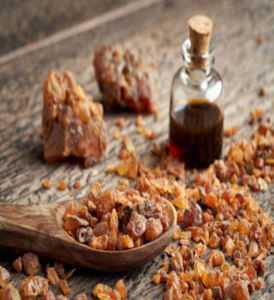
In two ways, it is called Myron.
First, the fragrance – oil composed from many fragrant plants is called Myron. Aromatic herbs are also called Myron. It Symbolizes the Fragrance of Christ, the Scent of Christ and spiritual renewal, and continuity of faith from the Apostles, (Apostolic Succession). Thus, it signifies the mortality of Our Lord for our sake. Derived from the Greek word Myrrh (Ointment), represents the Sanctification, Divine Grace and abiding presence of the Holy Spirit in a believer’s life.
Second, It signifies the sealing of a person with the gifts of the Holy Spirit after baptism. It is also known as the ‘Oil of Joy’ and we derive the gifts of the Holy Spirit. It represents the immortal nature of Christ, as it is used to embalm or consecrate.
1 John 2: 20 “But you have an anointing from the Holy One, all of you know the Truth“. This “Anointing” (Unction/Set Apart), the Holy Spirit given to believers, setting them apart and equipping them with divine, spiritual understanding. The believers possess anointing of the Holy Spirit which enables them to discern truth from deception, false teachings, specifically regarding the identity of Jesus Christ, providing spiritual insight to resist false teachings. “The Holy One”: This refers to Jesus Christ (Mark 1: 24).”Know the Truth”. Jesus of Nazareth? – I know who You are—the Holy One of God!” We, Believers possess an inner, spiritual awareness of the true gospel, that Jesus is the Son of God — who protect us from the deceptions of antichrists (false teachers). Ps. 72 This verse is also a warning against false teachers who left the Church, that we do not need secret knowledge, as the Spirit already teaches them.
1 John 2: 27: 27As for you, the anointing you received from Him remains in you, and you do not need anyone to teach you. But as His anointing teaches you about all things and as that anointing is real, not counterfeit—just as it has taught you, remain in Him. So, the anointing remains in us and teaches us all things. John 14: 26: Jesus promises the Holy Spirit, will teach and remind believers of His words.
The main elements of the Holy Myron is oil of olives and balsam, blessed by the head of the Church in a special manner and used in the administration of certain Mysteries & in the performance of certain ecclesiastical functions. In the Orthodox Church, olive oil and balsam oil (combined as holy Myron/Chrism) are used to represent the Holy Spirit, healing, and strengthening of believers.

For Chrism to serve as valid matter for the Sacrament of Confirmation, it must consist of pure oil of olives, and added some spices written in the Holy Bible. Olive oil symbolizes humanity and healing. Fragrant balsam represents the divinity of Christ and the “aroma of Christ“. Holy Mooron represents the Grace of the Holy Spirit, the sweetness of Christian virtue, and the call to carry Christ’s presence out into the world. These oils are essential for sacraments like Holy Chrismation, and the Consecration of Churches and Altars. These two conditions are certainly necessary for validity. Moreover, it is probable that there should be an admixture of balsam, and that the blessing of the Chrism should be special, in the sense that it ought to be different from that which is given to the oil of the sick or the oil of catechumens. Chrism (Gk. chrisma, from chriō, ‘anoint’). A mixture of olive oil and balsam used in Orthodox Churches and RC – with other ingredients, including nuts, and gum). Medieval and ecclesiastical Latin from Greek khrisma ‘anointing’, from khriein ‘anoint’.
The Aroma of Christ: 2 Corinthians 2:15 – The sweet fragrance of balsam represents the pleasing fragrance of Christ’s sacrifice and the sweet scent of a faithful life. 15For we are to God the pleasing aroma of Christ among those who are being saved & those who are perishing.
Strength and Healing: Olive oil base historically represents healing, strength, and resilience, Balsam resin represents the divine, transformative nature of the Spirit.
Sacramental Consecration: Chrism leaves an invisible but permanent spiritual mark, setting a person or object apart for God’s service.
Holy Mooron (Myron) – Old Testament Roots
The tradition of anointing with oil can be traced back to the Old Testament, where it was practiced as a ritual of consecration. One of the earliest mentions is in Genesis 28: 18 – 18 Early the next morning Jacob took the stone he had placed under his head and set it up as a pillar and poured oil on top of it, where Jacob anointed a stone pillar after his vision of a ladder reaching Heaven. (The Stone, the Pillar, House of God (Beth-El), and the Oil).
The recipe for holy anointing oil, described in Exodus 30:22–25, laid the groundwork for what would later become chrism oil in Christian traditions.
Anointing Oil: 22 Then the Lord said to Moses, 23“Take the following fine spices: 500 shekels of liquid myrrh, half as much (250 shekels) of fragrant cinnamon, 250 shekels of fragrant calamus, 24 500 shekels of cassia—all according to the sanctuary shekel, and a hin (1.5 gallon) of olive oil. 25Make these into a sacred anointing oil, a fragrant blend, the work of a perfumer. It will be the sacred anointing oil. “The primary purpose of anointing with the holy anointing oil was to sanctify, to set the anointed person or object apart as qodesh, or ‘holy‘ (Exodus 30:29). The oil played a vital role in ordaining priests, consecrating the Tabernacle and temples, and anointing kings. For instance, Samuel anointed David as a sign of his divine selection as king of Israel. Its use was highly restricted – reserved only for sacred purposes. The formula could not be replicated. It was forbidden for use on common people or outsiders. This strict sanctity and exclusivity paved the way for its eventual role in Christian liturgy.
Jericho is one of the places of the Hebrews which was rich in Palm trees, (Deut. 34: 3; Judg. 1: 16) and as well; other plants, there was also Balsam plant. Josephus the historian says Balsam oil was produced, when the its roots were cut with sharp stones, the gum oozes out from its roots, because of its fragrance, warmth and sweetness. Epiphanius, bishop of Cyprus says, when he explains the verse ‘the bunch of Cypress flower is my beloved in the garden of Engedi’ (Song 1: 14). Engedi is a place in Judea, on the western shore of the Dead Sea in Israel. in which the Balsam is produced, and there are gardens that provide it.
When this wood is cut, that is sliced; it gives the gum of Myron. Renowned for its year-round waterfalls, lush greenery, in the desert. It is famously known as the place where David hid from Saul. In O.T. times, Priests and kings were anointed with Holy Oil. (Lev. 8:10, 10:7, 1 Kin. 1:39). 10 Then Moses took the anointing oil and anointed the tabernacle and everything in it, and so consecrated them. 7 Do not leave the entrance to the tent of meeting or you will die, because the Lord’s anointing oil is on you. 39 Zadok the priest took the horn of oil from the sacred tent anointed Solomon. Then they sounded the trumpet, people shouted, “Long live King Solomon!” The Tabernacle, the Table of Shew-bread, and the altar of the burnt offering were also anointed. The Lord commanded Moses to consecrate the Holy Oil. (Ex. 30:22)
Holy Mooron (Myron) – New Testament Roots – Adoption in Christian Traditions
Olive oil, already central to Jewish rites, became a key element in Christian rituals. The Church also drew inspiration from both Jewish traditions. In the Old Testament, oil was used to anoint kings, priests, and prophets as a sign of divine selection and consecration. This practice influenced the use of oils in sacraments such as Baptism and Confirmation. Early Christian figures like Theophilus & Tertullian highlight the importance of chrism oil during the first two centuries. Cyril of Jerusalem provided detailed teachings on the anointing process, emphasizing that being “anointed with the Holy anointing oil of God” was a defining mark of a Christian.
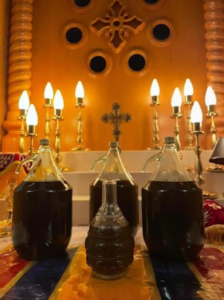
Church councils further solidified chrism oil’s sacred role. The biblical example of oil in ministry, as seen in Mark 6: 13 – “They anointed many sick people with oil and healed them“. The tradition of the Myron come down to us from the Jewish time of Moses. When God took him up to the mountain and taught him the mysteries of the Church. He also commanded him saying, `Take the finest aromatics: the flower of chosen Myron five hundred shekels, Cinnamon, Cassia and Olive oil etc. and make the oil of anointing, and you shall anoint the tent of the testimony, etc.'(Ex.30: 23-26). And this type was handed down till Christ and the old anointing of Moses came to an end, when (Our Lord) handed over to the Apostles. And (thus) the new anointing originated. In the New Testament times. Cannon of the Apostles:- “Those who are being Baptised should be anointed with blessed oil first, then Baptism with water, and finally with Holy Mooron.”
Composition and Preparation of Chrism Oil – Key Ingredients
Chrism oil is a blend of olive oil and a fragrant balsam. Olive oil forms the base, providing the foundation for this sacred mixture, while the balsam adds a sweet and aromatic touch to complete the traditional formula. Olive oil carries deep symbolic meaning. It represents nourishment, healing, and divine grace, making it an ideal element for anointing. Within the context of chrism, olive oil signifies the richness of God’s grace, emphasizing its role in conveying divine blessings. Its natural purity and restorative qualities further highlight its spiritual importance.
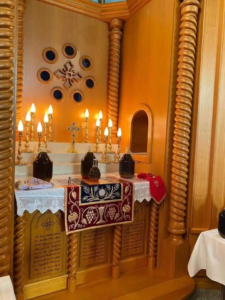
The balsam, with its sweet unique fragrance, also holds significant symbolism. It represents the sweetness of virtue and enhances the oil’s ceremonial presence. Beyond its practical use, the fragrance conveys a spiritual message. The balsam embodies the “aroma of Christ” (2 Cor 2: 15), reminding Christians of their mission to carry the essence of their faith into the world. Historically, other aromatic spices were sometimes included to reflect the care and reverence involved in crafting this sacred oil. Together, these ingredients form a blend that is both spiritually meaningful and ceremonially significant.
The word chrism, Greek Χρισμα (Khrizma – Chrisma), was used to designate any and every substance that served the purpose of smearing or anointing, such as the various kinds of oils and unguents. This was & is mentioned in early, ordinary sign in writings & in early patristic writings. Gradually, in the writings of the Fathers, the term came to be restricted to that special kind of oil, used in religious ceremonies & functions, in the administration of the Sacraments of Baptism & Confirmation. Our fathers, the apostles who granted this Sacrament by the laying of their hands after Baptism, as we read in the Book of Acts when St. Peter and St. John laid hands on the people of Samaria who were baptized in the name of the Lord Jesus, and so received the Holy Spirit (Acts 9: 2-6, 17). As the laying of hands for the dwelling of the Holy Spirit is a specific rite of the fathers the Apostles, their successors the Bishops. As Church grew geographically, It was not possible for the Apostles to go around all the countries and cities to lay hands on the baptized, so they established anointment by Myron as an alternative for the laying on of hands for the Holy Spirit’s indwelling.
The first who made the Myron were the Apostles, as they kept certain fragrant oils which were on the body of the Lord Jesus during His burial, and they added the spices which were brought by the women who prepared them to anoint Jesus’ body on Resurrection Sunday. The apostles melted all these spices in pure olive oil, prayed on it in Upper Room in Zion and made it a holy ointment to grant the gift of the Holy Spirit to the baptized. It is also used in the Sanctification of Baptismal water, Consecration of Churches, and Church altars. They decided that their successors the Bishops, must renew the making of the Myron whenever it was needed, by incorporating the original oil with the new.
Three Gospel scenes highlight lavish anointing:
• A woman “began to wet His feet with her tears… then she kissed His feet and anointed them with the perfume. Luke 7: 37-38
• A woman came to Him with an alabaster jar of very expensive perfume… and poured it on His head. Matthew 26: 7 / Mark 14:3
• “Mary took about a pint of pure nard… and anointed the feet of Jesus… the house was filled with the fragrance of the perfume. John 12: 3
The baptized is sealed with Myron for the following reasons: –
First, that we may acquire the fragrance that pleases God. Ast Paul has said: We are the aroma in Christ (2 Cor. 2: 15). – 15 For we are to God the pleasing aroma of Christ among those who are being saved and those who are perishing.
Second, moreover, it is the perfecter and the fulfiller of these divine gifts.
Third, it is a sign of Christ, by which the baptized is separated from alien flock.
Fourth, so that we may become fearsome to the demons, invincible to them.
Fifth, that He seals us on our senses so that they may not be entrances for sin.
He seals him with Myron on the forehead, that he may be terrifying to demons. Just as what happened in Egypt, when the destroyer did not approach the house which had the sign of the blood of the lamb, that is the sign of the cross. He is sealed with Myron upon the heart, that he does not become an abode of evil thoughts. He is sealed upon the joints, so that they may be instalments of justice, as said Paul (Rom. 6: 13) – 13 Do not offer any part of yourself to sin as an instrument of wickedness, but rather offer yourselves to God as those who have been brought from death to life; and offer every part of yourself to him as an instrument of righteousness.
0 Comments