Life after death, Eschatology and Eternal Life – The Parable of the Rich Man and Lazarus – Luke 16: 19 -31

“There was a rich man who was dressed in purple and fine linen and lived in luxury every day. At his gate was laid a beggar named Lazarus, covered with sores and longing to eat what fell from the rich man’s table. Even the dogs came and licked his sores. The time came when the beggar died, and the angels carried him to Abraham’s bosom. The rich man also died and was buried. In hades, where he (rich man) was in torment, he looked up and saw Abraham far away, with Lazarus in his bosom. So, he (rich man) called to him, `Father Abraham, have pity on me and send Lazarus to dip the tip of his finger in water and cool my tongue, because I am in agony in this fire’.
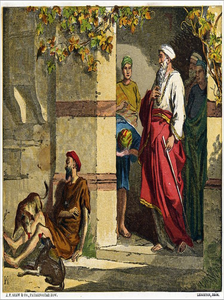
But Abraham replied, `Son, remember that in your lifetime you received your good things, while Lazarus received bad things, but now he is comforted, and you (rich man) are in agony. And besides all this, between us and you a great chasm has been fixed, so that those who want to go from here to you cannot, nor can anyone cross over from there to us. He (rich man) answered, `Then I beg you, father, send Lazarus to my father’s house, for I have five brothers. Let him warn them, so that they will not also come to this place of torment’. Abraham replied, `They have Moses and the prophets; let them listen to them’. `No, father Abraham’, he (rich man) said, `but if someone from the dead goes to them, they will repent’. He said to him, `If they do not listen to Moses and the Prophets, they will not be convinced even if someone rises from the dead'”.
1. The parable is about the life of the soul between a person’s death, (soul leaving the body) and before the Second Coming of Christ but not about life after the Second Coming of Christ. This interval is called the intermediate state of souls. Thus, the parable of the Rich Man and Lazarus does not refer to the life after Christ’s Second Coming, but to the life up to the Second Coming. Clearly it is about the so-called intermediate state of souls. After Second Coming of Christ, there bodily resurrection will take place, when the souls of saints, will enter their bodies again, and a person can enjoy the fruits of the things that he did in his lifetime. (Matt. 27: 52-53). Jn 6: 63: 63The Spirit gives life; the flesh counts for nothing. The words I have spoken to you—they are full of the Spirit & life.
2. It points out that death exists in every and any man’s life. Both the Rich Man and poor Lazarus died. ‘The time came when the beggar died…’, and ‘the rich man also died and was buried’. Death is the surest and most certain event in our life though the day and hour of death are uncertain. All people will have to taste the mystery of death. In other words, we are born to die. God did not create death, but death has inserted itself into nature, as a fruit of man’s sin and his withdrawal from God.
3. After Lazarus’ soul left his body, it was received by the angels and carried to Abraham’s bosom. This means that there are angels and, of course, each person’s guardian angel as his/her personal protector, who receive the souls of the just and take them to God. Therefore, at hour of death, when the soul is separated from its harmony with the body, the angels receive the souls of the saints, and the demons receive the souls of sinners. Of course, the souls of the saints, which have been united with Christ and bear the seal of the Holy Spirit, cannot be controlled by the demons. Human souls are received by angels or by demons is relative to their condition. Upon death, Lazarus is carried by angels to “Abraham’s side,” a place of comfort, whereas the rich man finds himself in torment.
Guardian Angel: The Orthodox Church believes that each person is assigned a guardian angel. Orthodox believe that you receive a guardian angel when you are baptized. Ps. 91: 11 For He will command His angels concerning you to guard you in all your ways; Ps. 34:7: “The angel of the Lord encamps all around those who fear Him, & delivers them”. “The [guardian] angel will not retreat from us, unless we drive him away by our evil deeds. As the smoke drives bees away, and stench the doves, even so our stinking sin drives away from us the angel who protects our life.” ~ Saint Basil the Great
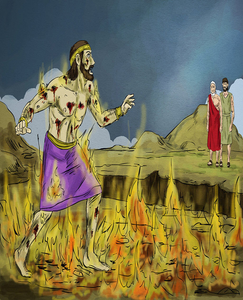
4. While Lazarus’ soul went to Abraham’s bosom and the Rich Man’s soul went to hades. It should be noted that in this parable Christ mentions the name of the poor man (Lazarus) but does not mention the Rich Man’s name. Christ says in the parable says, that Lazarus went to Abraham’s bosom and this particular Rich Man went to hades. This means that a real man is one who has a soul and a body but also the grace of God in his soul and body. This signifies that because Lazarus lived with God. Although a man who does not have the Holy Spirit is a person, he is not a person in relation to God, for the very simple reason that he has become enslaved to things.
5. The parable says that the Rich Man, finding himself in hades, saw Abraham “and Lazarus in his bosom“. It says that the Rich Man ‘saw Abraham afar off, and Lazarus in Abraham’s bosom’. To be in the bosom of God means to be in communion with God. So, the expression that Lazarus is in Abraham’s bosom points graphically to his communion with God. Lazarus, as being in Abraham’s Bosom “carried by the angels to Abraham’s side” (Lk. 16: 22). Abraham’s side-or “Abraham’s bosom” signifies a place of rest and honor, reminiscent of a banquet setting where one reclines upon a host’s chest. This position vividly depicts security, comfort, and fellowship with the faithful. It reflects the fulfillment of the covenant promised to Abraham-that he would be a father of many faithful descendants (Gen. 15: 6).
6. Lazarus does not seem to be troubled about the terrible hardship of the Rich Man. He does not see hades, while the Rich Man does see the glory of Paradise. Actually, a person, who lives in the uncreated Light, in the great vision of God, as our Fathers say, forgets the world. The Light is so great, so dazzling that it does not even allow one to see anything else.
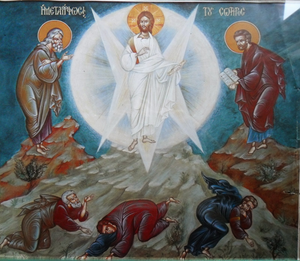
Uncreated Light is this spiritual light, which can illumine us during sincere prayer, when we converse with God our Creator and Lord, then our soul is illumined with that light for which we pray on the bright feast of our Transfiguration. The Prayer our Holy Church on this Feast day, recalls this wondrous event. ‘When Thou was transfigured on the mountain, O Christ our God, Thou didst show Thy glory to Thy disciples as far as they could bear it. Let Thy everlasting light shine also upon us sinners through the intercessions Of the Theotokos. Giver of Light, glory to Thee‘. Something similar applies to Holy Communion. All can take part, but for those who are prepared and fit it is light and life, for those who approach unworthily it is judgment and condemnation.
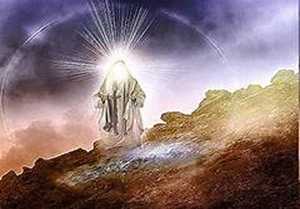
Light has two properties, illuminating and caustic. But if another person is deprived of his eye, if he is without sight, he is in dark and then he feels the caustic property of light. If one person has good vision, he benefits from the illuminating property of the sun, the light, and he enjoys the whole creation. He alone can never die (Immortal), and He lives in Light so brilliant that no human can approach Him. No human eye has ever seen Him, nor ever will. All honor and power to Him forever! Amen. 1 Tim. 6: 16. God alone possesses Eternal life and He is the light so brilliant that no human can approach or see Him directly; emphasizing God’s transcendent nature and glory, deserving of all honor and power forever.
7. The Rich Man was concerned about his brothers living in the world and asked Abraham to send Lazarus to preach repentance to them. Therefore, in spite of the separation of a man’s soul from the present world, there is knowledge and social interest. However, since those who did not repent before their soul left the body do not have spiritual vision, they experience only the caustic energy of God and will never participate in the good. But we pray for all, because we do not know their inner spiritual condition. The rich man is troubled and tormented, indicating an experience of anguish consistent with judgment. The rich man’s location is described as Hades (Greek: ᾅδης), often referring to the realm of the dead, distinct from the final lake of fire (hell) in Rev. 20:14-15. From here, he tries to plead for relief but fails to receive any. His pleas even extend to warning his earthly family, suggesting that he recognizes, but too late the importance of repentance and righteous living.
8. It says in the parable that there was a “great gulf” between hades, where the Rich Man was, and the place where Abraham was, and that it was not possible to pass from one to the other (vs. 26). This refers to particular ways of life. There is a clear difference between Paradise and Hades as particular ways of life. God sends His Grace to all men alike since, “He makes His sun rise on the just and the unjust and sends His rain on the evil and the good“. But each person feels God’s love differently, according to his spiritual condition.
9. Abraham, who did not comply with the Rich Man’s plea to send Lazarus to earth and exhort his brothers to repent, justified his position by saying that if people do not listen to Moses and the Prophets, “they will not be convinced even if someone rises from the dead”. A carnal man cannot repent, however many miracles he may see in his life. He lives in a deathly sleep. There is a denial of Second Chances. A “great chasm” separates the two states (Lk. 16: 26). This permanently fixes each person’s position, emphasizing the urgency of heeding God’s revelation in this life.
10. We have Holy Scripture, the lives of the Prophets, Apostles and Saints, we have their words and their teachings, as well as their holy relics, and we believe that there is eternal life. At times each of us is granted by God to experience in his heart what is Hell and what is Paradise. Beyond these things, we keep Christ’s commandments in order to be cured, so that we can solve many existential, interpersonal, social and ecological problems. To abide by God’s commandments makes us balanced people.
There is a profound contrast between their earthly lives and their eternal destinies. The parable also speaks to the reality of an afterlife with distinct experiences for the righteous and the unrighteous. Both the rich man and Lazarus exhibit conscious thought, speech, and awareness after death (Lk. 16: 23-24). This implies that the soul endures beyond physical death. The departed have social knowledge of the world. The rich man answered, “Then I beg you, father, send Lazarus to my father’s house, for I have five brothers. Let him warn them, so that they will not also come to this place of torment’ (Lk. 16: 27 – 28).
0 Comments